I’ve been following Mobile Legends: Bang Bang esports since the early M-series days, but when MOONTON Games announced that Japan and the rest of East Asia would finally get a proper seat at the global table, it felt like watching a master weaver thread a missing filament into an already dazzling tapestry. The official word landed just days ago: the Hero Asian Champions League will now host the MCT East Asia 2026, and the tournament—running from 22 to 24 May at Shanghai’s futuristic Star Ring Center—marks the first time MLBB has been woven into the ACL ecosystem.
This isn’t just another regional qualifier. It’s the clarion call before the Asian Games thunder, a mini-forge where the six best teams from Japan, China, South Korea, and Mongolia will bang their shields together and decide who gets a ticket to the global midsummer feast. The stakes are deliciously straightforward. Four slots to the Mobile Legends: Bang Bang Mid Season Cup 2026 at the Esports World Cup 2026 are on the line. The champion rides straight into the MSC Main Event, while the 2nd, 3rd, and 4th-place teams snatch the Wild Card berths—the only route for East Asian squads to break into that international arena. If you miss this train, you’re spectating from the sideline.
The revelation of such a pathway tastes especially sweet because, during the M7 World Championship last year, MOONTON quietly dropped an atlas of its grand ambition: a five-region strategy that carved the global MLBB landscape into dedicated circuits—SEA, EECA, Europe/MENA, the Americas, and East Asia. MCT EA 2026 is the kinetic pulse that brings that East Asian skeleton to life. I hear echoes of Mike Chu, MOONTON’s Head of East Asia Esports, who painted the moment as a milestone not just for the region’s competitive growth but for every overlooked talent pool that now has a clear corridor toward the brightest stages. What he said resonates like a tuning fork: “Together with Hero Esports, we are proud to bring the top teams from China, Japan, South Korea, and Mongolia onto one competitive stage, creating greater opportunities for regional talent to compete, grow, and reach the international spotlight.”
The competing teams have already clawed their way through domestic qualifiers, and the lineup reads like a recipe for fireworks. China sends GZG and YBG, two squads that have rapidly evolved from hungry underdogs into methodical powerhouses. Mongolia brings the MongolZ and The Modun—teams that carry the weight of a nation with far more esports ferocity than their population numbers might suggest. Japan’s Sunset Ravens and South Korea’s Feiyun Esports complete the six-pack, each representing distinct schools of tactical thought. This cross-pollination of styles is exactly why I think of the tournament as a Melting Cauldron of Converging Philosophies: the crisp rotational discipline from Korea colliding with China’s chaotic creativity, Japan’s patient macro meeting Mongolia’s unapologetically aggressive early-game stampedes.
To sharpen the competitive edge, the tournament organizers have introduced a two-group structure that feels genuinely thoughtful rather than a cosmetic tweak. There’s a Mythical Group and a Legendary Group. The Mythical tier—GZG, The MongolZ, and Sunset Ravens—get a direct pass to the Knockout Stage, like noble houses waiting in the high keep. Meanwhile, the Legendary Group—YBG, The Modun, and Feiyun Esports—must first burn through a single round-robin Best-of-Three Qualification Stage on 22 May to earn their seats at the big table. Only the top three from that brawl advance.
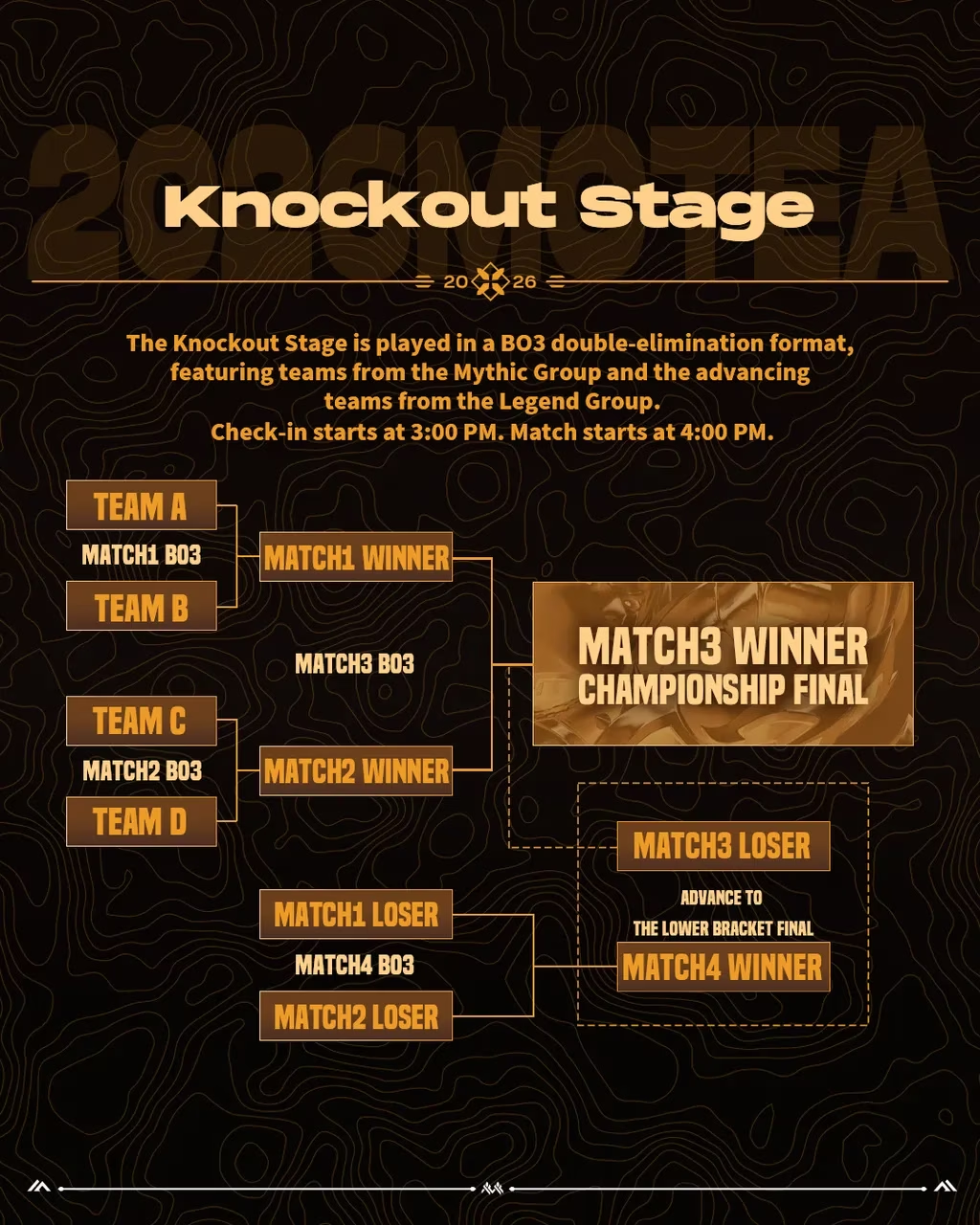
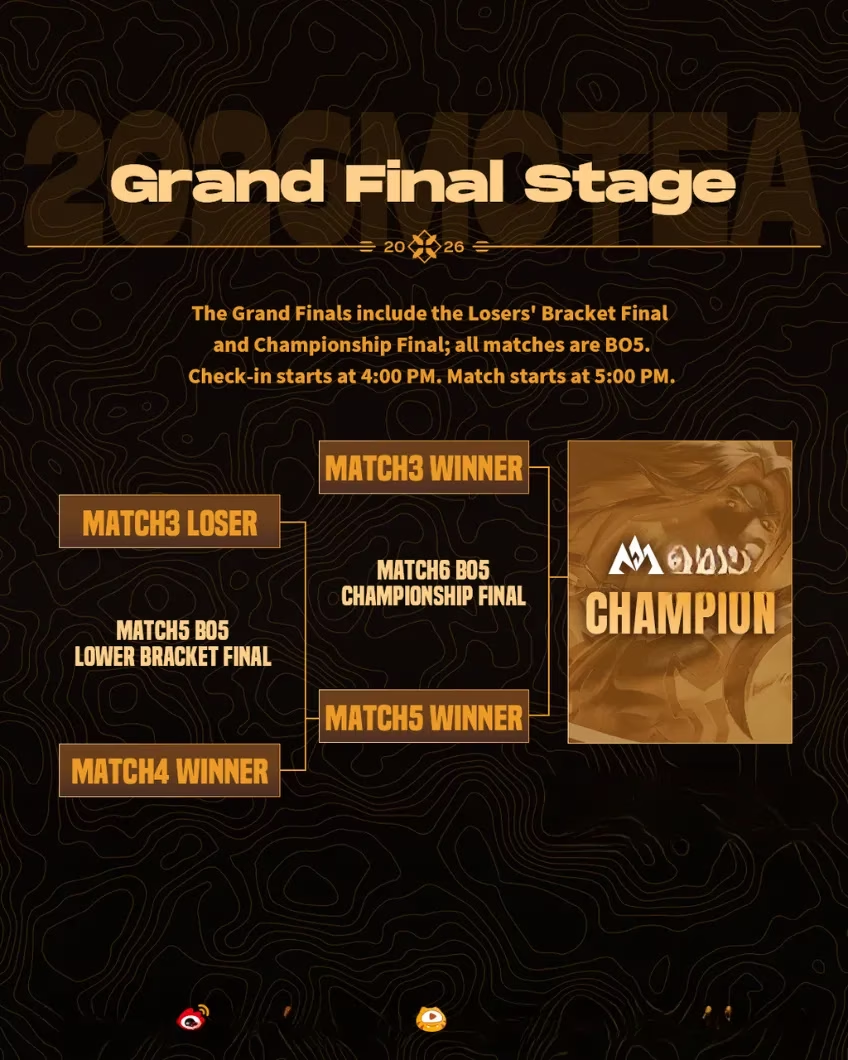
Once that dust settles, the 23 May Knockout Stage becomes a BO3 double-elimination gauntlet that merges all six warriors. This bracket is where things get delightfully treacherous—lose once and you slide into the losers’ trench, but a second stumble and the dream evaporates. I love this format because it rewards consistency while still leaving room for a miraculous lower-bracket run. The Grand Finals on 24 May will switch to a Best-of-Five, so by then the true marathon runners will separate from the sprinters. The schedule is tight and electric:
-
📅 22 May – Qualification Stage (17:00): Legendary Group BO3 single round-robin. Three advance.
-
📅 23 May – Knockout Stage (16:00): Full double-elimination bracket with all six teams in BO3 matches.
-
📅 24 May – Grand Finals (17:00): Losers’ Final and Grand Final, both BO5 epics.
For a fan like me, witnessing the birth of an integrated East Asian MLBB circuit feels akin to standing on a beach and seeing the tide pull back before a tsunami—the real wave is the Asian Games horizon, and this is the important rehearsal. It’s also the first time East Asia gets a pan-regional platform just for Mobile Legends, meaning rivalries that used to exist only in ladder nightmares will finally collide on LAN. The fact that spectator registration is already open tells me the Star Ring Center will be packed with voices chanting in at least four languages.
Looking forward, MOONTON’s commitment goes far beyond this single event. The promise of investing in talent pipelines, infrastructure, and the broader mobile esports ecosystem makes me cautiously optimistic that East Asia’s MLBB scene won’t just be a guest at global tournaments—it could soon become the host. For now, though, all eyes fix on May’s crucible in Shanghai, where four golden tickets to the Esports World Cup await those brave enough to seize them.