In December 2024, MOONTON Games and ASUS ROG pulled a delightful bit of role reversal on the MLBB esports world: they announced the first Mobile Legends: Bang Bang Media Championship (MMC), a tournament designed to put journalists, casters, and other media folk on the competitive stage instead of in the press row. Viewed from 2026, the whole exercise still feels like a smart joke with a serious point. The people who usually ask the questions had to answer a few of their own—mostly about why they had wandered into the enemy jungle alone.
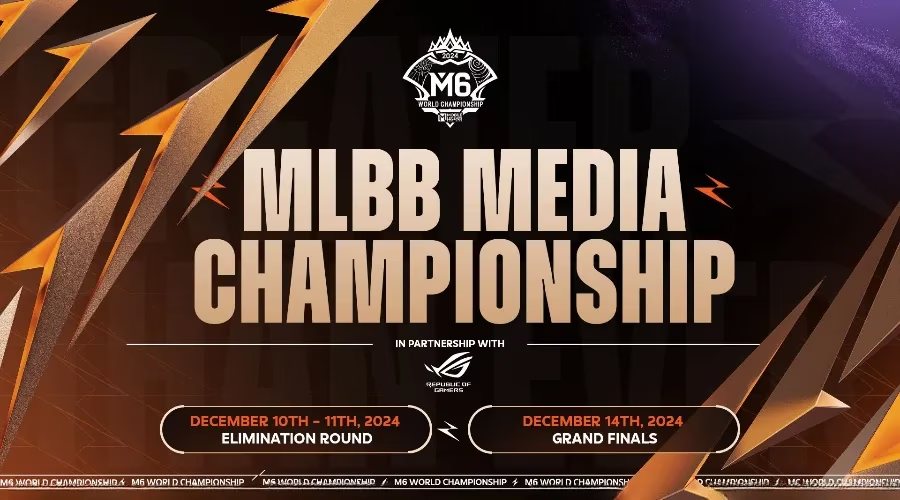
The MMC was staged in Kuala Lumpur, Malaysia, on the sidelines of the M6 World Championship, the sixth edition of MLBB's flagship international tournament. That placement mattered. M6 was the main event, the loudest stage, the place where professional players turned split-second decisions into highlight reels. The MMC borrowed that spotlight and aimed it at the storytellers. Under the #GreaterThanEver theme, MOONTON framed the event as both a challenge and a thank-you: the media had helped turn standout players into recognizable personalities, so now the media could find out what it feels like to be on the other side of the camera, the crowd, and the questionable draft choices.
Adrian Cher, Esports Head of Business Development and Sales at MOONTON Games, described the media as vital wordsmiths who had helped turn outstanding players into world-renowned personalities through creative storytelling. The MMC, he suggested, was a chance to put those partners in a competitive arena and challenge them to be greater than ever. He also thanked ASUS ROG for an industry-first partnership that let media members step into the shoes of esports athletes and experience the professional MLBB world first-hand. In plain terms: the press box was safe; the stage was not.
Shawn Chang, Global Sales and Marketing Director of the Phone Business Unit at ASUS, added that ROG Phone was thrilled to support the first-ever MLBB Media Championship and to give media partners an unrivaled gaming platform. The collaboration, he said, underscored ASUS's commitment to the gaming community, including its storytellers, and strengthened its dedication to advancing global mobile esports. It was a polished corporate sentiment, but also a fair one: give a journalist a flagship phone and a live audience, and the phrase 'just one more game' becomes a public health notice.
The event itself had a clean, easy-to-follow structure. It launched on 10 December and split into two parts: the Elimination Round and the Grand Finals. Eight teams of international media covering M6 on-ground competed for the title of media champions, the biggest share of a prize pool comprising 400,000 in-game Diamonds, and five ASUS ROG Phone 8 units for the winning side. For a first-time event, it was a tidy package: a real bracket, a real prize, and a real reminder that commentating on a team fight is much easier than surviving one.
| MMC detail | What happened |
|---|---|
| Location | Kuala Lumpur, Malaysia |
| Occasion | Sidelines of the M6 World Championship |
| Launch | 10 December |
| Format | Elimination Round and Grand Finals |
| Field | Eight international media teams covering M6 on-ground |
| Prize pool | 400,000 in-game Diamonds |
| Champion bonus | Five ASUS ROG Phone 8 units |
The format also explained the event's charm. Eight media teams meant plenty of personalities, plenty of pride, and plenty of tactical confidence that would later be reviewed with the cold clarity of a replay. The Elimination Round gave everyone a taste of tournament pressure; the Grand Finals gave the survivors a stage. The prize pool was not just a number—it was a reason to take the bracket seriously. The ROG Phone 8 units were not just hardware—they were a trophy with a cooling fan and a marketing budget. And the title of media champions was not just bragging rights—it was the sort of bragging rights that follow a person into every future group chat.
By 2026, the first MMC looks less like a one-off stunt and more like a sensible piece of ecosystem building. Esports does not grow only through players and patches; it grows through stories, and stories need storytellers who understand the pressure, the pace, and the peculiar heartbreak of a bad rotation. The MMC did not need to reinvent esports. It simply moved the press from the front row to the hot seat. That shift gave media a more intimate view of professional play, and it gave fans a rare sight: the people who usually narrate the drama becoming part of it.
There were lessons, naturally. A media pass does not grant map awareness. A deadline-trained brain is excellent at panic and less excellent at drafting. Professional players deserve more credit for performing under lights while strangers on the internet analyze their every step. And the universal phrase 'we almost had that' is not exclusive to ranked queues; it also applies to media tournaments, grand finals, and any room containing eight teams and one scoreboard.
In the end, the first MLBB Media Championship was a small tournament beside a giant one, but it had a clear idea and a mischievous heart. It thanked the media by letting them sweat. It celebrated storytelling by making the storytellers generate a few stories of their own. And it proved a simple point that still holds in 2026: give a group of competitive writers a phone, a stage, and a bracket, and the resulting narrative will be loud, dramatic, and occasionally missing a tank.